EdgeQuant is a single trading system that reads the market, sizes the risk and carries the decision through to execution. Each market runs on its own strategy, and the three are unified into a single system. Running all three together is the complete form, because a weak stretch in one is absorbed by the others - but you can start with a single market.
02 What we trade
Nasdaq, Gold, Bitcoin.
Different sessions, different characters. Nasdaq trades the New York morning, gold the Asia session, and bitcoin only on Sundays.
NQNasdaq 100 futuresThe Pillar
◷ New York morning
Accumulates opportunity in rising markets and takes shorts in declines rather than leaning on one direction.
+176RMDD 37.9R2014-2026 walk-forward
GCGold futuresThe Duelist
◷ Asia session
Wins on risk/reward, not win rate - asymmetric stops cut losses short and let winners run.
+153RMDD 34.4R2017-2026 walk-forward
BTCBitcoinThe Hunter
◷ US afternoon session, Sundays only
Trades only on Sundays when the trend gate opens - stands aside in unclear markets, and commits only when the trend is defined.
+100RMDD 20.0R2021-2026 walk-forward
Each asset entered the portfolio at a different time, so cumulative R cannot be compared directly between them.
Sessions spread across the day - no overlap
GOLD, Asia, dailyGOLD
NQ, NY, dailyNQ
BTC, US, SunBTC
00:0006:0012:0018:0024:00 UTC
Natural diversification. Nasdaq and Gold trade daily in their own sessions; Bitcoin trades only the Sunday session, when the rest of the market is closed. Different asset markets, different hours - a bad day in one is rarely a bad day in all.
You can start with one. The three-market record above is the destination, not the entry ticket. Accounts connect per asset, and the system runs with only one of the three connected - signals for all three arrive either way, and you choose which to execute. Without capital of your own, the prop route opens gold and Nasdaq at normal size; to start smaller, bitcoin trades in fractional size on a crypto exchange with no contract minimum.
03 The System
More Than a Signal.
Most signal services provide price direction only. EdgeQuant systematizes everything from the call to risk and execution.
EdgeQuant System
1 Market Understanding
↓
2 Quant Decision
↓
3 Risk Management
↓
4 Portfolio Allocation
↓
5 Automated Execution
From prediction to portfolio execution.
We trade only as much as needed. EdgeQuant works off the 4-hour bar. Nasdaq and gold take at most one entry per trading day and close at a set time four hours later; bitcoin takes at most one entry on Sunday and is held until a bar closes against the position, up to 24 hours. No scalping, no adding to a losing position - each asset enters by its own fixed rule and exits on its own fixed condition.
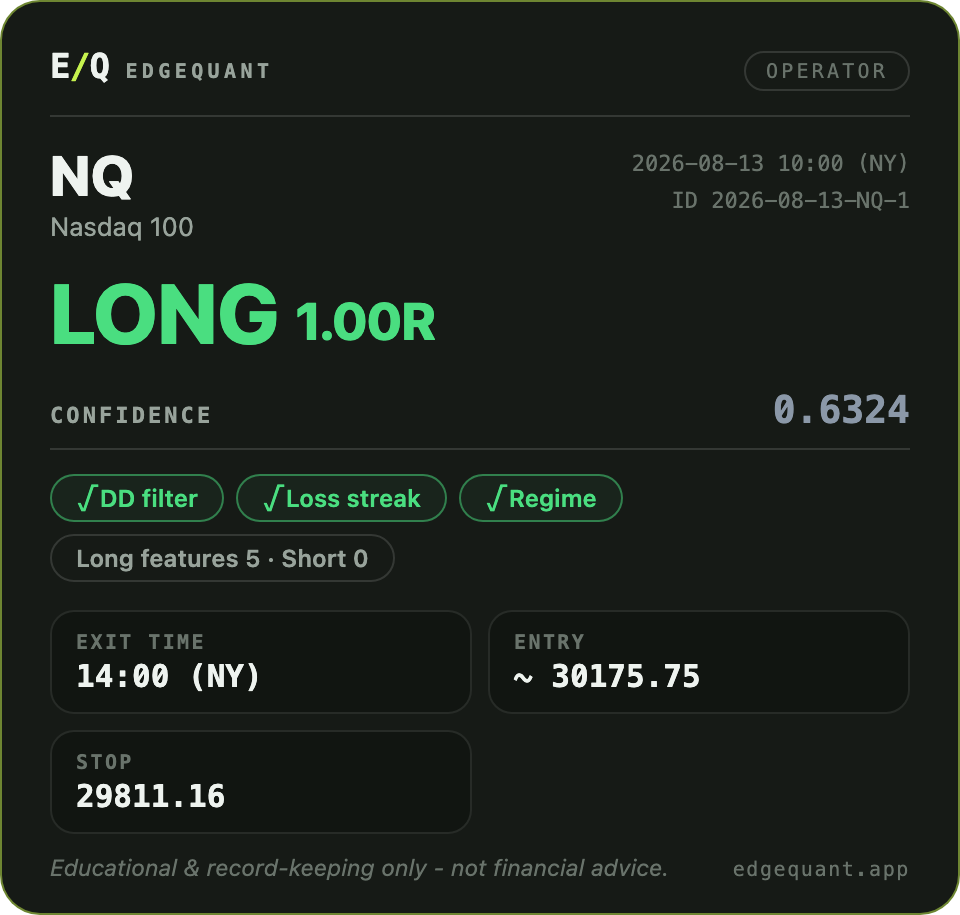
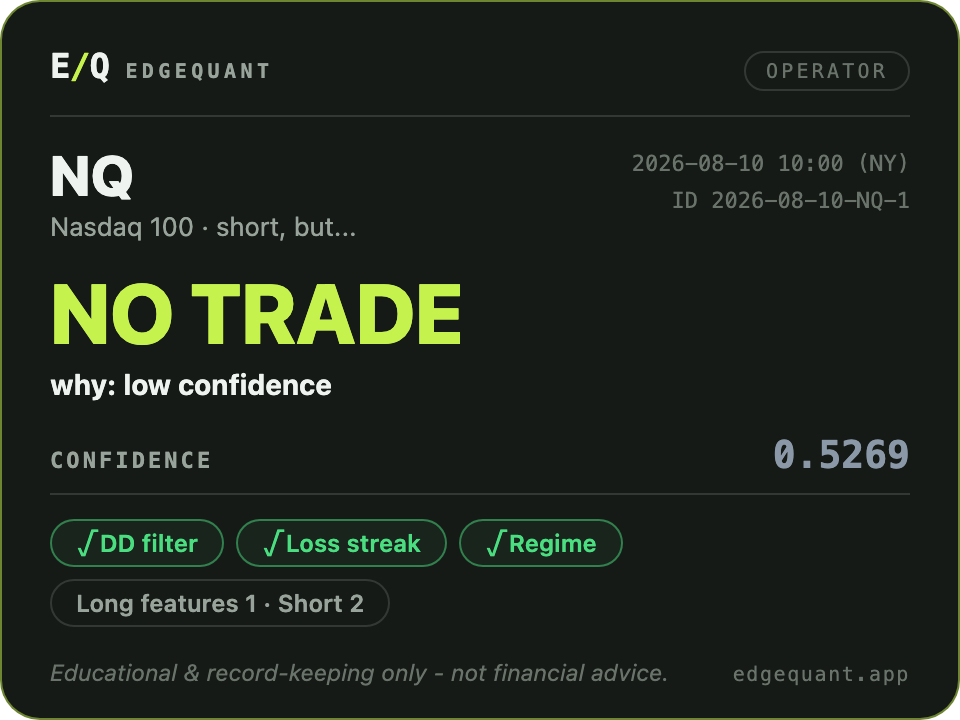
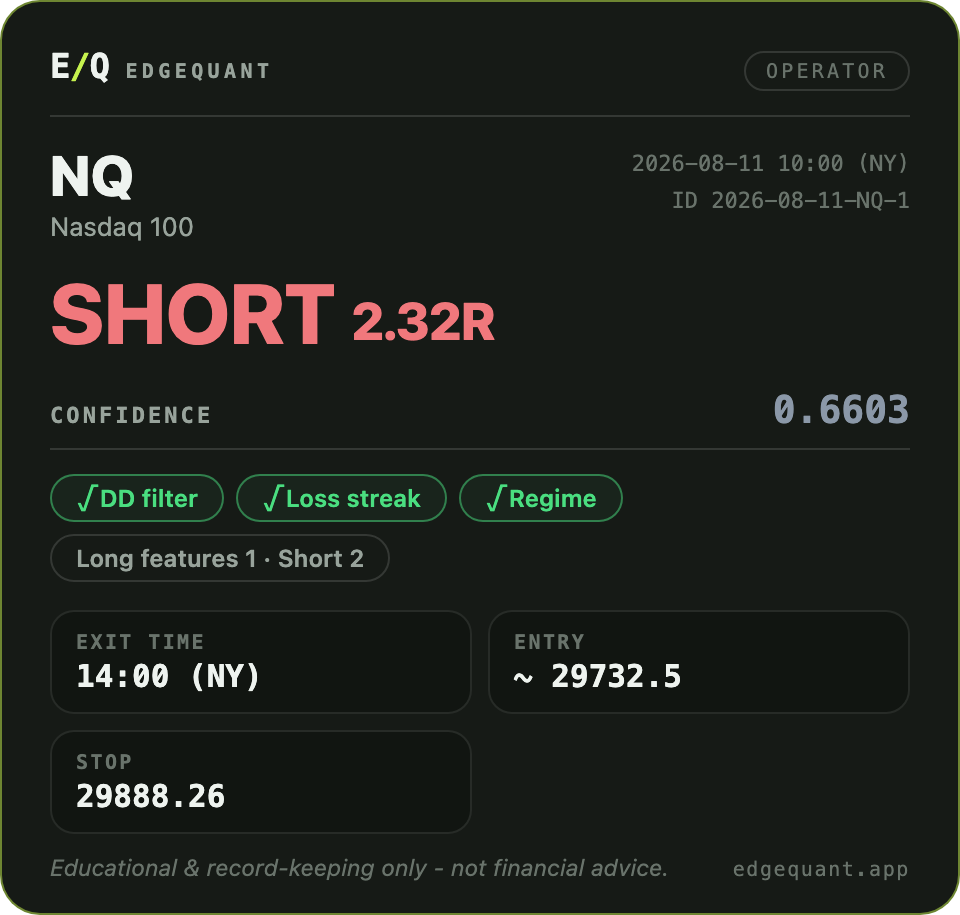
Signals reach every member in the same format.
Sent 2026-08-13 - NQ longSent 2026-08-10 - NQ, stood downSent 2026-08-11 - NQ short
Two directions, and a deliberate flat. Instrument, direction, entry reference, stop, exit time, model confidence and the filters that passed - every member receives the identical card. When the conditions are not met, the card states NO TRADE together with the reason. Standing aside is a decision the system makes, and it enters the record on the same terms as a trade.
The R figure next to the direction is relative position size, not an amount of money. Confidence is the gate that decides whether to enter at all; it does not set the size. The target multiple varies from 1R to 3R with the market regime.
From there, execution is handled by EQ Autopilot. ↓
04 EQ Autopilot
Not a signal copier.A complete execution engine.
From automatic signal detection to execution.
EQ Autopilot is the desktop application that turns EdgeQuant Signals into orders automatically. It runs on your own machine, through your own API keys and account; you set the risk, and the system calculates the position size. So even on the same Signal, order size and participation can differ from user to user.
Supported brokers · Topstep (ProjectX) · Lucid Trading · Tradovate · IBKR · Bitget · Bybit. More are being added.
What running it requires
EQ Autopilot runs on your computer, so the machine must be on and online at entry and exit times. Entry times are 23:00, 15:00 and Monday 07:00 KST. To keep it running while you are away, an always-on environment such as a VPS is needed. If the machine goes down while a position is open, the stop order stays alive - stops rest at the broker or exchange, not in the app. Timed exits, though, do not happen until the app runs again; until then the defence is the resting stop order. No new entries occur while the app is off. If the app stops responding, we notify you within 15 minutes via Telegram or Discord - so you never mistake a dead app for a running one. Once set up, day-to-day care is a few minutes of checking.
01Portfolio allocationCapital spread across NQ, Gold and Bitcoin by design, not guesswork.
02Automatic position sizingThe system sizes every trade - from 1R up to a 3R cap by market conditions, never by discretion.
03Entry & exit automationOrders and risk management are handled automatically based on EdgeQuant signals.
04Risk controlHard stops, drawdown limits and regime filters enforced automatically.
Go Live - one switch arms the markets you checkedPer-asset accounts - your brokers, your risk unit
The actual EQ Autopilot app - click either shot for the full window
EdgeQuant does not hold your funds, and does not exercise discretion over your account on your behalf. You can stop execution at any time, and control always stays with you.
Security and permissions - you do not hand over a key; only the minimum permission is granted. We never ask for exchange withdrawal permission, and futures-broker APIs have no withdrawal function at all. With NinjaTrader, credentials never pass to the app. API secrets stay in your computer’s OS secret store, and what we receive is the R multiple of a result and its timestamp - no balances, account numbers, or keys. One caveat: to actually place orders, stops and closes, a read-only key will not work. We take the minimum permission required - and disclose the full scope.
What we ask for, broker by broker
Bybit and Bitget: one permission is enough - contract trading (orders and positions). There is not a single withdrawal or transfer API call in the app. One write we name plainly: if your balance falls short just before entry, the app raises that symbol’s leverage setting - a trading-scope write, not a wallet permission. The raise applies to that one symbol only, never beyond the exchange’s own cap, never downward - and actual risk stays pinned to the stop, at most 1R.
TopstepX cannot split key permissions - but zero of its documented endpoints move money, and payouts require tax forms and bank verification on the Topstep dashboard. Tradovate’s new keys default to everything-denied; we need one write domain (orders) and three read-only ones. With NinjaTrader (Lucid), you log in inside NinjaTrader and the two programs talk only inside your own machine.
Key storage: macOS Keychain / Windows Credential Manager, never sent to EdgeQuant servers.
05 Access
One system. Three ways to run it.
The same EdgeQuant decisions, used the way you want - from verification, to manual execution, to full automation.
Pricing early September → membership opens 13 October
Preview
Verify
See the Edge in the open.
The full track record and delayed live signals, out in the open. Evaluate the system before committing capital.
Every entry with its stop, in real time - plus lead alerts 10 minutes before entry and 5 before exit. You place the entries yourself, so this tier fits someone who can act at the entry times (23:00, 15:00, Monday 07:00 KST); the desktop app can close them for you. Automatic entry is the Autopilot tier.
Position sizing and entry/exit handled for you - running on your own machine, with your own keys. We never hold your funds; control of the account always stays with you. The tier is about how execution runs, not how many markets you trade - it applies the same whether you run one market or three.
What matters more than the number is how it was produced.
Walk-forward validation, and the same signals running live on the architect’s own accounts - the process is open to inspection, not just the outcome.
Walk-Forward Validated Public Live Track Record Net of Fees & Slippage
+429R
Cumulative result (walk-forward validated) - repeated out-of-sample testing, not hindsight fitting
52.8RMax drawdownlargest peak-to-trough decline · 24 months to a new high
8.1Recovery Factorcumulative return ÷ max drawdown
Walk-forward means the model is trained only on past data, then tested on unseen future data - repeated period after period. Every figure here was produced without knowing the future, not fitted in hindsight. All figures are net - exchange fees, commissions and slippage are already deducted, and every leg - entry, timed exit and stop - is modelled as a market fill. We assume no saving from limit orders. The slippage assumption is half a tick per futures leg (0.002% per crypto leg); a 2-tick stress version lives in the robustness tests.
How long the deepest drawdown lasted. It began in April 2016; the new high came in April 2018 - 24 months. Using this system means holding the same rules for 24 months without a new high. (The max drawdown spans two calendar years, which is why it is larger than any single worst year - the two numbers measure different windows.) 24 months under water also means 24 months of fees - which is why the subscription can pause: once a year, up to three months, billing stops, the free tier takes over, and a founding rate lock survives the pause (cancellation loses it).
10 / 13
Positive years
-11R
Worst year (2015) · Nasdaq only
+171R
Best year (2024)
3
Independent markets combined
Year
Nasdaq
Gold
Bitcoin
Portfolio (R)
2014*
+13.6
—
—
+13.6
2015
-10.9
—
—
-10.9
2016
+4.8
—
—
+4.8
2017
-1.2
-8.6
—
-9.8
2018
+9.8
+53.9
—
+63.7
2019
-8.3
+31.2
—
+22.9
2020
+17.9
+19.7
—
+37.5
2021
+0.4
-14.8
+9.1
-5.3
2022
-4.8
+6.0
+9.8
+11.0
2023
+9.6
+40.2
+0.8
+50.6
2024
+123.7
+12.7
+34.8
+171.2
2025
+2.6
+10.3
-0.8
+12.1
2026*
+18.6
+2.4
+46.4
+67.4
Reading these figures: 2024 contributed +171R - about 40% of the total; excluding it, the Recovery Factor falls from 8.1 to 4.9. Since 2021, when all three assets have run together, the result is +307R with a max drawdown of 31.5R. The 52.8R max drawdown, by contrast, occurred in 2016-2018, before Gold and Bitcoin joined. First and current years are partial; — means the asset was not yet in the portfolio.
In money terms
the default is 1R = $600 - a unit set from micro-contract risk, and the same base used for the architect’s live accounts and the fee-adjusted tables. So the cumulative +429R is +$257,400, the worst year (2015, -11R) is -$6,600, and the 52.8R max drawdown is -$31,680. 1R is an amount you choose; every performance figure scales by it.
Why three markets together
because one market’s weakness can be absorbed by another’s strength. In 2022, Nasdaq was -4.8R - but gold (+6.0R) and bitcoin (+9.8R) offset it, and the portfolio finished +11.0R. Every market’s weak stretches and recoveries are in the record.
Validation continues in live accounts
the architect has been executing the same signals in their own 150K prop accounts since May 2026, publishing every fill. Architect's public track record → Two accounts (Topstep and Lucid) run the same signal in parallel, so one decision is recorded as two fills; folded to decision level, the live result is +15.2R.
Backtest and live can differ
The system keeps being improved during the live period, so the two are not exactly the same system, and the live sample is still small. So far the difference runs in live’s favour - we treat it as a deviation all the same. Every day the live sends are checked against the next day’s walk-forward recomputation, and an audit re-derives each send decision to watch for mismatches.
Equal-weight portfolio of NQ, Gold, Bitcoin - record from October 2014 to August 2026. Maximum risk on any single trade is capped at 3R.
07 The Journey
From verification to your own capital.
Different starting points, one destination - running EdgeQuant in an account of your own.
1VerifyEvaluate the live track record - before any capital is committed.
→
2Build capitalWithout capital of your own, the prop route is the main path; on your own capital, one account of about $50,000 runs gold and Nasdaq together. The simulation results for both routes are right below.
→
3Full scaleCompound in your own account with preservation-focused sizing - 1R grows with capital.
Build capital - simulation results
Prop route: pass an evaluation and you trade at normal size on funded capital. Automated execution at the challenge and funded stages is confirmed per firm, in writing (exceptions and caveats on the prop page). From simulation on past signals: pass rate near 18%, 5-6 attempts on average to a funded account - about $1,400 over roughly 3 months. Simulated, not guaranteed.
Own capital: about $50,000 for both markets together - not per market. One micro contract risks a fixed amount and cannot be traded in fractions, so the account only has to cover the larger of the two (Nasdaq, about $45,000); gold, at about $31,000, is then covered by the same account. Bitcoin trades in fractional size on a crypto exchange, so it has no contract minimum - it runs the Sunday session only.
By our calculation, with the membership fee included, the net expectation after fees holds up from roughly $50,000 of your own capital. Below that, watching the record for free - or the prop route, which puts none of your own capital at risk - comes out as the better starting point.
Everything is free until launch. That window itself is the verification period, and paid membership first opens on 13 October. Pricing and founding-member terms are announced in early September, and no payment is taken before the company’s registration is complete.
Cancel any time · 14-day withdrawal after payment · support@edgequant.app
Risk disclosure. Trading futures and derivatives carries a substantial risk of loss and is not suitable for all investors. Past and walk-forward (simulated) performance shown here does not guarantee future results. EdgeQuant provides information for education and research - it does not provide investment advice, recommendations or asset management services. You manage your own account and risk, and all trading decisions and their outcomes are your own responsibility.